
ADHD-Friendly Tools That Make Family Life Easier
Practical supports for time blindness, transitions, organization, sensory regulation, and executive functioning
If your family is always searching for a missing water bottle, realizing at 8:42 p.m. that tomorrow is pajama day, or saying, “We have to leave in five minutes!” for the fourth time, you are not failing at organization.
Your family may simply need more supports outside of your brains.
ADHD affects executive functioning: the mental skills that help us begin tasks, remember steps, estimate time, shift attention, organize belongings, regulate emotions, and follow a plan. These skills are still developing in all children, and they can require additional support for children and adults with ADHD.
The goal is not to create a perfectly organized home. It is to reduce how much everyone has to remember, make important information easier to see, and build systems that work with your family's brains.
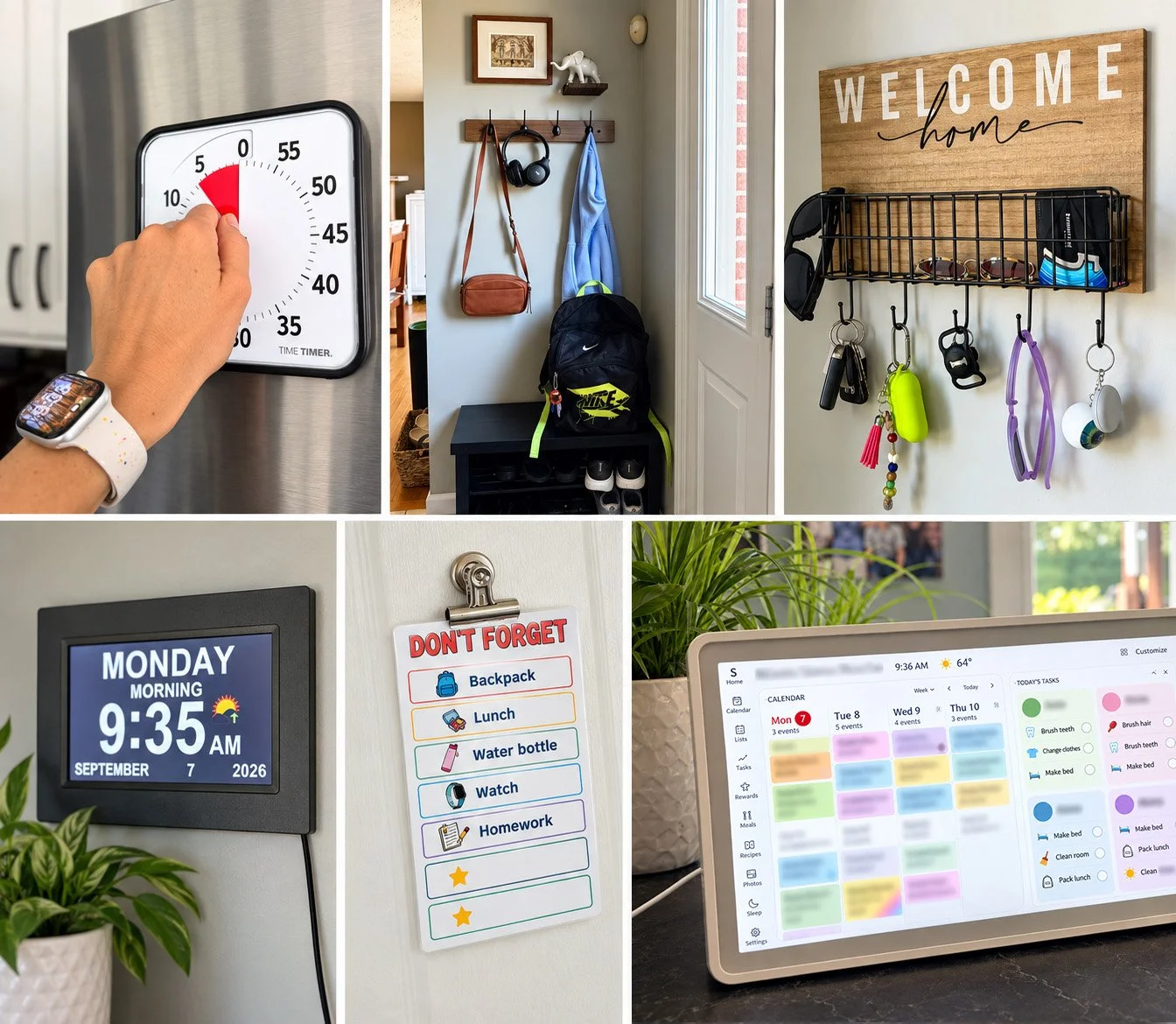
Here are some of my favorite ADHD-friendly tools and strategies, both as a parent and as a pediatric speech-language pathologist:
Make time visible with a visual timer
Many people with ADHD experience time blindness, or difficulty sensing the passage of time, estimating how long something will take, and recognizing when it is time to stop one activity and begin another.
A clock tells you what time it is. A visual timer shows you how much time is left.
I especially like the [Time Timer](https://www.timetimer.com/pages/adhd) because its colored disk gradually disappears as time passes. A child does not have to repeatedly read numbers or calculate how much time remains. They can see it at a glance.
Try using a visual timer for:
getting dressed or completing a morning routine
screen time
homework or a short “work sprint”
waiting for a preferred activity
getting ready to leave the house
giving advance notice before a transition
Instead of abruptly announcing, “Time to go,” try: “We are leaving in 15 minutes. Would you like to set the timer?” Add a five-minute reminder if that is helpful.
Timers should provide information, not pressure. Some children become anxious when they see time disappearing. If that happens, experiment with a longer countdown, a gentler sound, verbal check-ins, or a visual schedule without a timer.
Executive function support: time awareness, planning, task initiation, sustained attention, and cognitive flexibility.
Use a large digital day-and-date clock
A large wall clock that displays the time, day of the week, and full date can be surprisingly helpful. Put it where your family naturally looks, such as the kitchen, hallway, or near the exit.
This gives everyone a shared reference point and reduces questions such as:
“What day is it?”
“Is dance today?”
“How long until we leave?”
“Is the appointment tomorrow or next week?”
Look for a display that is uncluttered, readable from across the room, and not excessively bright at night.
Executive function support: orientation to time, working memory, planning, and independence.
Create one family calendar everyone can see
Digital calendars are only helpful when people remember to open them. A calendar placed in a busy area of the home makes the family schedule visible without requiring anyone to search for it.
We use a Skylight Calendar(https://myskylight.com/calendar), a touchscreen family calendar that can combine schedules in one color-coded display. A shared digital calendar may be useful for appointments, activities, chores, meal plans, and changes to the usual routine.
You do not need an expensive device to get the same basic benefit. Try:
a large desk calendar hung on the wall
a dry-erase monthly calendar
a weekly whiteboard in the kitchen
a printed weekly schedule on the refrigerator
one color for each family member
Choose one main “home base” rather than creating several systems that must all be updated. Review it together once a day, perhaps during breakfast or before bed.
Executive function support: prospective memory (remembering to do something later), planning, organization, and anticipating transitions.
Put a visual checklist by the door
The doorway is the point of performance: the place where remembering the backpack actually matters. That makes it a better location for a checklist than a planner tucked inside the backpack.
A simple visual checklist might include:
shoes
backpack
lunchbox
water bottle
homework or folder
watch or phone
instrument, sports gear, or dance clothes
Use words, photos, or simple icons depending on your child's needs. Laminate the list and add dry-erase checkboxes, or make each item detachable with hook-and-loop dots. Keep the list short enough to scan quickly.
Executive function support: working memory, sequencing, self-monitoring, and task completion.
Build a “launch pad” for leaving the house
Pair the door checklist with one predictable place for items that need to leave the house. This might be a basket, hook, shelf, or bin for each person.
Place backpacks, library books, returns, forms, and activity supplies there as soon as they are ready. A basket near the stairs can also collect items that need to move to another floor.
The less searching required during a transition, the better.
Executive function support: organization, future planning, and reducing the number of steps needed to start a task.
Make storage obvious and easy
“Out of sight, out of mind” is a very real experience for many ADHD brains. If an item disappears into an opaque container or complicated storage system, it may effectively stop existing.
Try:
clear bins for toys, craft supplies, snacks, and school materials
open baskets for frequently used items
labels or pictures on dresser drawers
broad clothing categories such as “shirts,” “pants,” and “pajamas”
hooks instead of hangers when hanging something is too many steps
lid-free bins when lids create an extra barrier
The best organizational system is not necessarily the prettiest one. It is the one your family can use on an ordinary, tired Tuesday.
Executive function support: categorization, organization, working memory, and follow-through.
Use days-of-the-week clothing shelves
A hanging organizer labeled Monday through Friday can reduce morning decisions. Children can choose outfits for the week in advance and place any special items with them, such as a team shirt or gym clothes.
If preparing an entire week feels like too much, even choosing clothes the night before removes one task from a busy morning.
Executive function support: planning ahead, sequencing, decision-making, and morning task initiation.
Create visible snack and supply stations
Clear, reachable containers can help children find an appropriate snack, pack part of a lunch, or replace a household item with less adult direction. You might create:
a refrigerator bin with ready-to-eat snacks
a pantry basket with school-safe choices
a homework station with pencils, chargers, and scissors
a self-care basket with hair supplies, deodorant, or toothbrush backups
Keep choices limited enough that the station remains easy to scan. Restock it at a predictable time each week or use automatic delivery for items your family uses consistently.
Executive function support: independence, task initiation, decision-making, and completion of routines.
Support movement while thinking
Movement is not automatically a distraction. For many children and adults with ADHD, appropriate movement helps the nervous system reach a more alert, organized state for listening, talking, reading, or completing work.
My kids love our peanut-shaped therapy ball. They provide more stability than a round ball, although the downside is that they take up a lot of space. Other options include:
a foot resistance band around chair legs
a wobble cushion
a rocking chair
a standing workspace
short movement or heavy-work breaks
carrying laundry, pushing a full basket, or moving books
Movement tools work best when matched to the person and task. The question is not, “Are they sitting still?” It is, “Is this helping them participate?”
Executive function support: regulation, alertness, sustained attention, and impulse control.
Experiment with calming sleep supports
Sleep can be difficult when a busy brain and body have trouble shifting into a quieter state. A predictable sensory routine may help signal that the day is ending.
Some older children and adults enjoy the gentle compression of a stretchy sleep pod, we like the brand, Hug Sleep(https://hugsleep.com/), or the pressure of a weighted blanket. Others prefer a body pillow, soft blanket, fan, quiet music, or compression sheet.
Sensory tools are highly individual. A support that feels calming to one person can feel hot, restrictive, or uncomfortable to someone else. Never force a sensory tool, and make sure the user can remove it independently.
Important safety note: Ask your child's pediatrician or occupational therapist if you have questions about whether a weighted or compression product is appropriate.
Executive function support: regulation and the transition from activity to rest.
Attach trackers to the things that disappear
Apple AirTags (https://www.apple.com/airtag/) or [Tile trackers](https://www.tile.com/) can reduce the time and stress spent looking for keys, bags, wallets, or other frequently misplaced belongings.
I also love my Apple Watch because I can use it to ping my iPhone, set timers, and quickly add an item to a grocery or ideas list. The most helpful tool is often the one that is already on your wrist when the thought occurs.
Technology cannot teach executive function by itself, but it can provide an external cue exactly when and where it is needed.
Executive function support: working memory, time management, and recovery from misplaced items.
Get tasks out of your head immediately
Working memory is limited. Trying to mentally hold “return the library book, buy toothpaste, sign the field-trip form, and email the teacher” uses energy that could be spent elsewhere.
I use, Google Tasks in Google Calendar, (https://support.google.com/calendar/answer/9901136) to capture tasks and give time-sensitive items a date. Other options include:
a shared phone reminder list
a voice assistant
a small notebook that always stays in the same place
a family whiteboard
a notes widget on the phone's home screen
Pick the fewest capture locations you can realistically maintain. If tasks live in six apps, three notebooks, and several screenshots, the system creates another searching problem.
Executive function support: working memory, prioritization, planning, and task initiation.
Digitize school papers before they disappear
School papers multiply quickly. When a paper contains information you may need later, scan or photograph it immediately, then store it in one easy-to-find place.
I like the document-scanning feature in Apple Notes. You could also create an album in Apple Photos for each child or school year. Useful items to save include:
school calendars
activity schedules
permission forms
concert or spirit-day information
teacher contact information
Add important dates to the family calendar before filing or recycling the paper.
Executive function support: organization, information retrieval, and prospective memory.
Reduce the number of steps
When a routine repeatedly falls apart, look for friction rather than a lack of motivation.
Ask:
Can the hamper go where clothes naturally land?
Can toothbrushes be kept in more than one bathroom?
Can chargers stay where devices are usually used?
Can frequently forgotten supplies live in both the house and the car?
Can we buy duplicates of inexpensive essentials?
Can the trash can, hooks, or basket move closer to the place they are needed?
Small environmental changes can be more effective than repeated reminders because they reduce the executive-function load every single time.
Executive function support: task initiation, planning, organization, and habit formation.
Start with one pain point
Please do not read this list and decide that your family needs 15 new systems by Monday.
Choose the moment that creates the most stress. Is it leaving for school? Changing activities? Finding belongings? Settling for sleep? Start there, choose one support, and test it together.
Ask your child what would make the routine easier. Keep what helps. Adjust or remove what does not. ADHD-friendly support is collaborative, flexible, and individualized.
External supports are not “cheating,” and they do not prevent children from developing independence. A useful support allows a child to participate more successfully now while they gradually build skills, self-awareness, and confidence.
How pediatric speech-language therapy can help
Executive functioning and communication are closely connected. A child may know what they want to say or do but have difficulty organizing the steps, holding directions in mind, shifting between tasks, starting an assignment, or communicating when overwhelmed.
At Beyond Behavior Speech & Language Therapy, I help neurodivergent children and their families understand what is getting in the way and build practical, individualized supports for communication, regulation, and executive functioning. My approach is strengths-based, collaborative, and focused on making daily life work better, not simply increasing compliance.
If you are looking for a pediatric speech therapist in the Pittsburgh area who understands ADHD, autism, executive functioning, and regulation, contact Beyond Behavior to learn more about parent coaching and speech-language therapy services in Allison Park, Pennsylvania.
This post is for educational purposes and is not individualized medical advice. Product links are provided for convenience. Beyond Behavior is not affiliated with the brands mentioned unless clearly stated.