
Beyond Behavior 101: What Is Regulation?
If you've ever wondered why your child can handle something one day but completely fall apart over the exact same thing the next, regulation may be a big part of the answer.
We often talk about children's behavior as though it is simply a matter of choice:
They know better.
They're just not listening.
They're being difficult.
They need to learn that behavior isn't okay.
But behavior doesn't happen in a vacuum.
Before we can understand what a child is doing, it helps to understand what is happening underneath the behavior.
And that's where regulation comes in.
So... What Is Regulation?
Regulation is our nervous system's ability to adjust our level of alertness, emotion, attention, and energy so that we can respond to what's happening around us.
When we're regulated, we have greater access to the parts of our brain responsible for things like:
flexible thinking
problem-solving
communication
impulse control
attention
emotional control
perspective-taking
Regulation does not mean being calm all the time.
A regulated child can be excited. Loud. Energetic. Frustrated. Disappointed. Angry.
Regulation means their nervous system is able to respond to those experiences without becoming so overwhelmed that they lose access to the skills they need in that moment.
Think of Regulation as a Window
Every nervous system has a range in which it functions best.
Inside that range, a child might be able to hear:
"We're leaving in five minutes."
...and feel disappointed but transition anyway.
When their nervous system becomes overwhelmed, that exact same request might result in yelling, running away, arguing, crying, shutting down, or refusing to move.
The request didn't necessarily change.
Their capacity did.
And capacity can change throughout the day.
Sleep, hunger, sensory input, social demands, transitions, anxiety, unpredictability, cognitive demands, masking, boredom, illness, and accumulated stress can all affect how much a child's nervous system can handle.
This is one reason a child may genuinely be able to do something sometimes and struggle tremendously with it at other times.
Dysregulation Doesn't Always Look Like a Meltdown
When we hear "dysregulated," we often picture a child screaming, hitting, throwing things, or having a huge meltdown.
But dysregulation can look like many different things.
It might look like:
becoming silly or hyperactive
arguing about seemingly insignificant things
controlling other people's actions
refusing
running away
becoming unusually loud
repeating questions
getting "stuck"
crying easily
shutting down
hiding
becoming extremely quiet
saying "I don't know" to everything
suddenly being unable to make a decision
appearing not to hear you
Sometimes the behavior we are trying hardest to stop is actually our first clue that the child's nervous system is struggling.
Regulation Before Reasoning
This is one of the most important ideas I want parents to understand:
A dysregulated brain does not have the same access to thinking skills as a regulated brain.
When the nervous system detects threat or becomes overwhelmed, the brain prioritizes survival and protection.
That means the skills we are asking a child to use, such as reasoning, flexible thinking, language, impulse control, or problem-solving, may become much harder to access.
That's why during the peak of a meltdown, explanations like:
"We've talked about this."
"Use your words."
"You know the rule."
"Why are you acting like this?"
may accomplish very little.
The issue isn't necessarily that the child doesn't know.
They may not be able to access what they know in that moment.
This is why regulation often needs to come before reasoning, problem-solving, teaching, or repairing.
So How Do We Help a Child Regulate?
There isn't one universal "calming strategy."
And regulation isn't something adults simply teach children to do independently and then walk away.
Children develop self-regulation through repeated experiences of co-regulation.
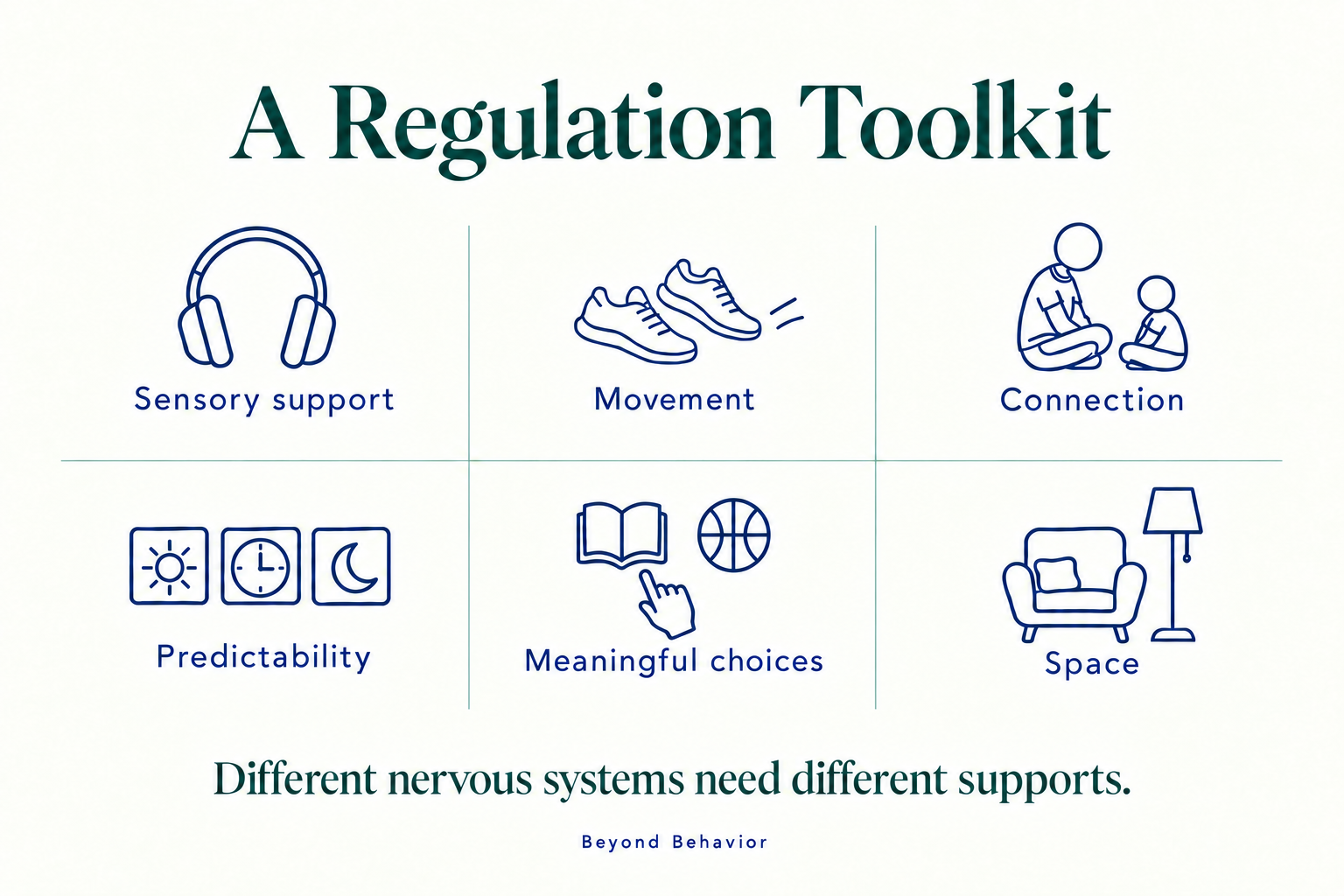
That might mean:
reducing language
slowing down your own voice and body
offering connection without demanding it
providing movement or heavy work
reducing sensory input
offering sensory input the child seeks
providing predictability
offering meaningful choices
reducing demands temporarily
using humor or play when appropriate
giving the child space without withdrawing support
The goal isn't to find the magic strategy that makes a child calm down.
It's to become curious about what this particular nervous system needs in this particular moment.
Over time, we can also help children build their own personalized regulation toolkit: strategies, sensory supports, environmental changes, communication tools, and routines that help their nervous system return to a state where they can engage again.
We'll talk much more about that later in the Beyond Behavior 101 series.
Behavior Is Information
Looking at behavior through a regulation lens doesn't mean ignoring unsafe behavior or eliminating boundaries.
It means changing the question.
Instead of only asking:
"How do I get this behavior to stop?"
we can also ask:
"What is making this hard right now?"
"What might their nervous system be communicating?"
"What skill is difficult to access in this moment?"
"What support could help them get back to a place where they can use that skill?"
That shift from judgment to curiosity can change the way we respond to children.
Because sometimes what looks like a child who won't...
is actually a child who, in that moment, can't yet.
And understanding that difference is where we begin to look beyond behavior.
Regulation-Focused Support for Pittsburgh Families
If your child struggles with emotional regulation, ADHD, autism, executive functioning, meltdowns, or challenging behavior, you don't have to figure out what's happening underneath those behaviors alone.
Beyond Behavior Speech & Language Therapy is a neurodiversity-affirming pediatric therapy practice located in Allison Park, serving families throughout Pittsburgh and the North Hills of Pittsburgh.
I work with children and parents using a regulation-first approach that looks beyond the behavior to understand nervous-system needs, communication, executive functioning, and the skills a child may be struggling to access.
Services include child therapy and parent coaching, with support available for families navigating ADHD, autism, executive-functioning differences, emotional regulation, and challenging behavior.
If you're looking for neurodiversity-affirming support in the Pittsburgh area and wondering whether Beyond Behavior might be a good fit for your family, I offer free 15-minute consultations.